VisoMaster vs Rope Pearl: How the Rope Lineage Evolved
Rope Pearl vs VisoMaster Studio: where Rope came from, what VisoMaster and Fusion changed, and which Rope habits and files still carry over today.
Rope Pearl is a May 2024 release of Rope, Hillobar's desktop face swapper built around the Inswapper128 model. VisoMaster came later from two developers active in the Rope community, and VisoMaster Fusion continues VisoMaster today. VisoMaster Studio is a separate desktop app built on Fusion's processing code. If you learned face swapping on Rope Pearl, most of the ideas carry over: assign a source face to each target face, use markers to change settings mid-clip, and stack masks and a restorer on top of the swap.
This post traces that history from the repositories themselves and compares Rope Pearl with VisoMaster Studio 0.3.0.
Where Rope came from
Rope. Hillobar's repository (github.com/Hillobar/Rope) was created in July 2023 and describes itself as a "GUI-focused roop". Its README says Rope "implements the insightface inswapper_128 model with a helpful GUI". Releases were named rather than numbered: v1.0 (July 2023), Space Worm, Crystal, Crystal Shard, Sapphire, Opal (February 2024) and Pearl.
Rope Pearl. Published on 27 May 2024. Its release notes list selectable swap output resolution (128, 256 or 512), easier selection of input images, switching between mean and median merging, keyboard controls and a gamma slider. Pearl is a Python app with a Tkinter interface, and its requirements pin CUDA builds of PyTorch and ONNX Runtime.
Rope Bronze. Rope did not stop at Pearl. In July 2026 Hillobar published Rope-Bronze, which the README describes as having a new, more responsive interface, a TensorRT engine, an XSeg masker and a capture mode.
Community forks. In parallel, Rope users maintained their own forks. Alucard24's fork, whose README calls its builds "Rope-Next", added work on DeepFaceLab (DFM) models and TensorRT. argenspin's Rope-Live, forked from it, describes itself as a fork of Hillobar's Rope that adds webcam input, virtual-camera output and DeepFaceLive model support, for Windows with NVIDIA GPUs.
VisoMaster. The VisoMaster repository credits argenspin and Alucard24. Its commit history starts in September 2024, the public repository was created in January 2025, and the first release, v0.1.1, was published on 8 February 2025. VisoMaster switched to a Qt (PySide6) interface and ships a tool to convert old Rope embedding files to its own JSON format.
VisoMaster Fusion. Created in October 2025, with v1.0.0 in November 2025 and v3.12.3 in August 2026. Its README says it "builds on the original VisoMaster work" and lists Windows 10 or 11 as the operating system, recommends an NVIDIA GPU, and offers CUDA, TensorRT and CPU providers.
VisoMaster Studio. Built on VisoMaster and VisoMaster Fusion v3.12.3, with a new single-window interface for Mac and Windows. It is a separate project, not a release from the VisoMaster or Fusion maintainers.
Rope Pearl vs VisoMaster Studio
| Rope Pearl (May 2024) | VisoMaster Studio 0.3.0 | |
|---|---|---|
| Interface | Tkinter desktop window | Desktop window (Tauri and React) with a Python processing back end; interface text in Chinese for now |
| Setup | Python environment and requirements, models downloaded separately | Installer with Python runtime and FFmpeg included; models download on first use |
| Hardware | CUDA builds of PyTorch and ONNX Runtime | Apple Silicon (CoreML or CPU); Intel Mac CPU (preview); Windows CPU and NVIDIA CUDA (previews) |
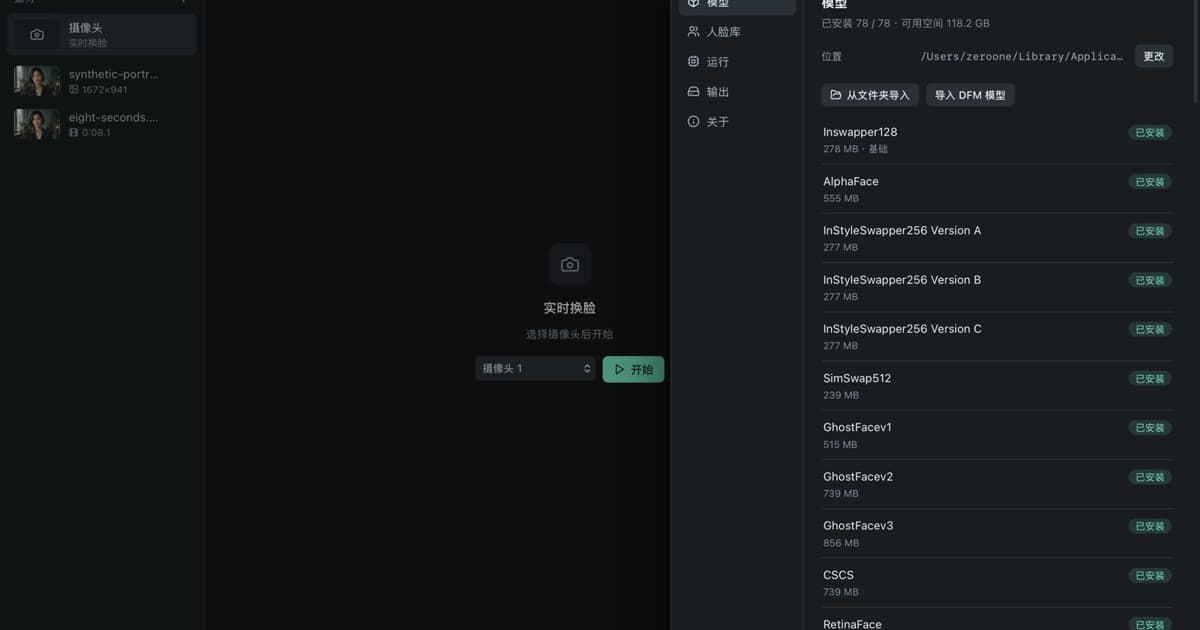
| Swap models | Inswapper128 at 128, 256 or 512 output | Inswapper128 (128 to 512 or Auto), AlphaFace, InStyleSwapper256 A/B/C, SimSwap512, GhostFace v1–v3, CSCS, DeepFaceLive .dfm; optional second swapper blended in |
| Face detectors | RetinaFace, YOLOv8, SCRFD | RetinaFace, SCRFD, YOLOv8, YuNet |
| Face restorers | GFPGAN, CodeFormer, GPEN 256/512 | GFPGAN v1.4 and 1024, CodeFormer, GPEN 256–2048, RestoreFormer++, VQFR v2; optional second restorer |
| Masks | Occluder, face parser, mouth parser, CLIP text, border blur, differencing | Occlusion, XSeg, face parser by region, CLIP text, border, texture transfer, differencing |
| Merging reference photos | Mean or median | Mean or median |
| Saved embeddings | Rope text file | VisoMaster JSON; Rope text files can be loaded |
| Parameter markers | Yes | Yes, plus ranges, joined segments and an issue scan |
| Expression and editing | Not included | LivePortrait expression restore, face editor, makeup, re-aging |
| Webcam | Not in Pearl (added in community forks) | Live mode with optional virtual-camera output |
| License | GPL-3.0 | GPL-3.0 source; paid packaged installer; models keep their own licenses |
What carries over from Rope
Rope users will recognise the core workflow in Studio:
- Per-face assignment. Rope assigns source faces to the target faces found in the current frame. Studio does the same: faces in the current frame of the selected media are detected, and you map a reference face to each one you want to change. Faces you leave unmapped are not swapped.
- Merged references. Rope Pearl merged several photos of one person with mean or median math. Studio offers the same two options.
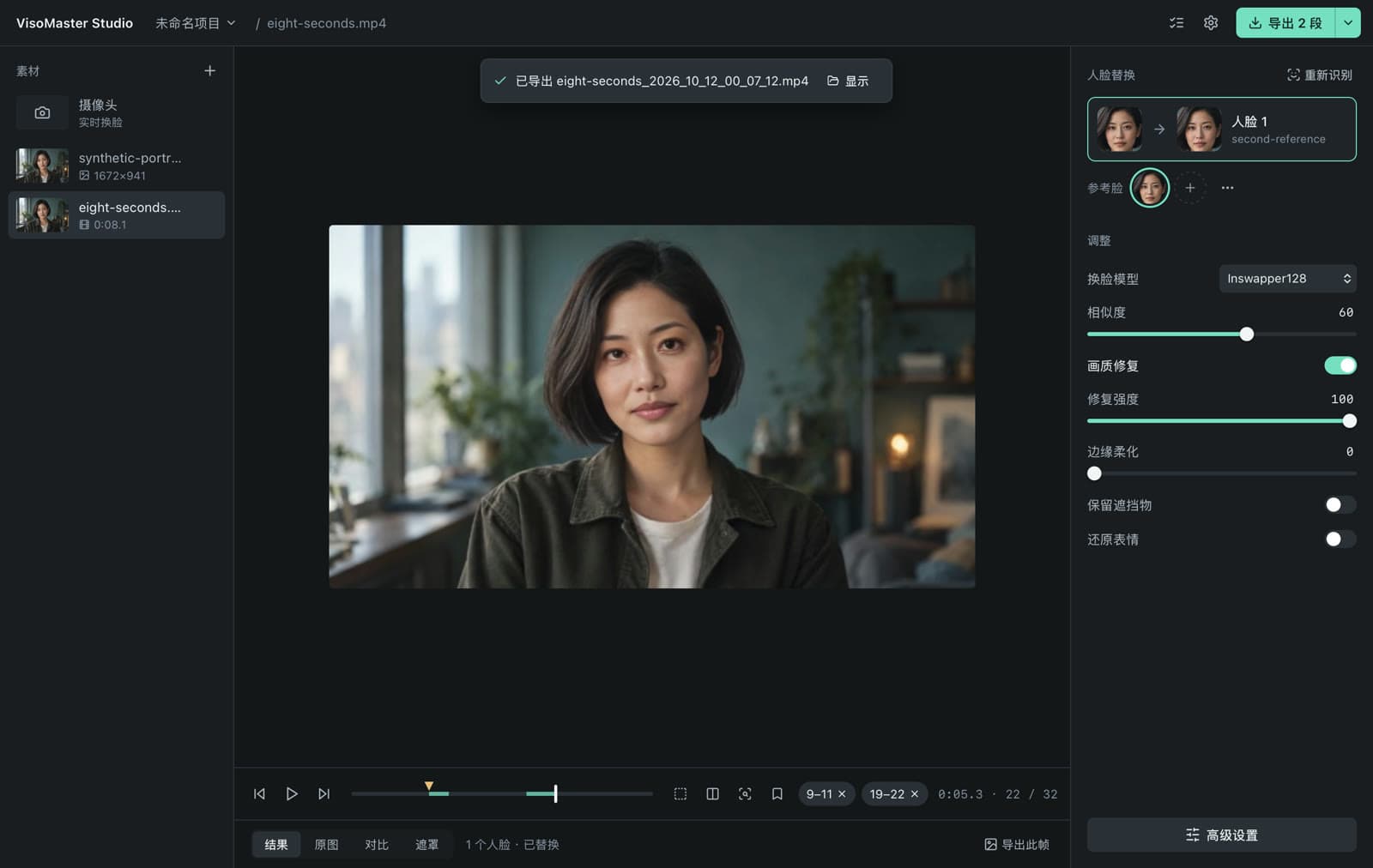
- Parameter markers. Rope's markers copy all settings at a frame and apply them until the next marker. Studio keeps markers, so you can change settings from a given frame onward.
- Saved faces. Rope stores merged embeddings in a text file with a "Name:" line followed by the values. Studio's face library loads that format and also reads and writes VisoMaster JSON. A Rope file holds values for one recognition model only, so it applies to the swappers that use that model.
What is different
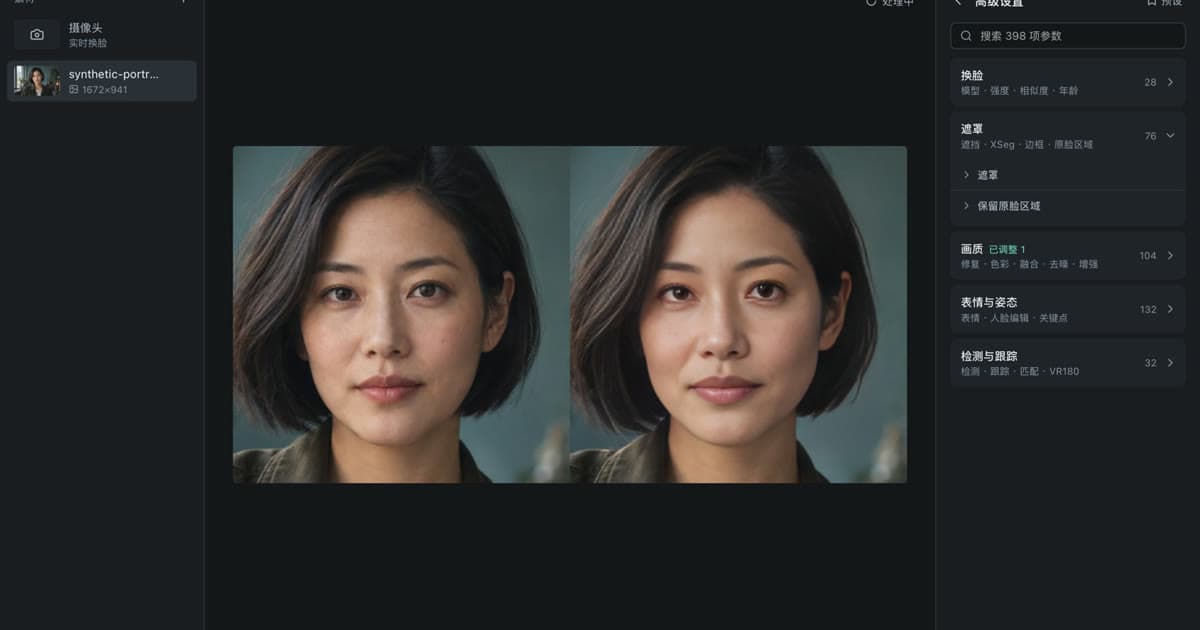
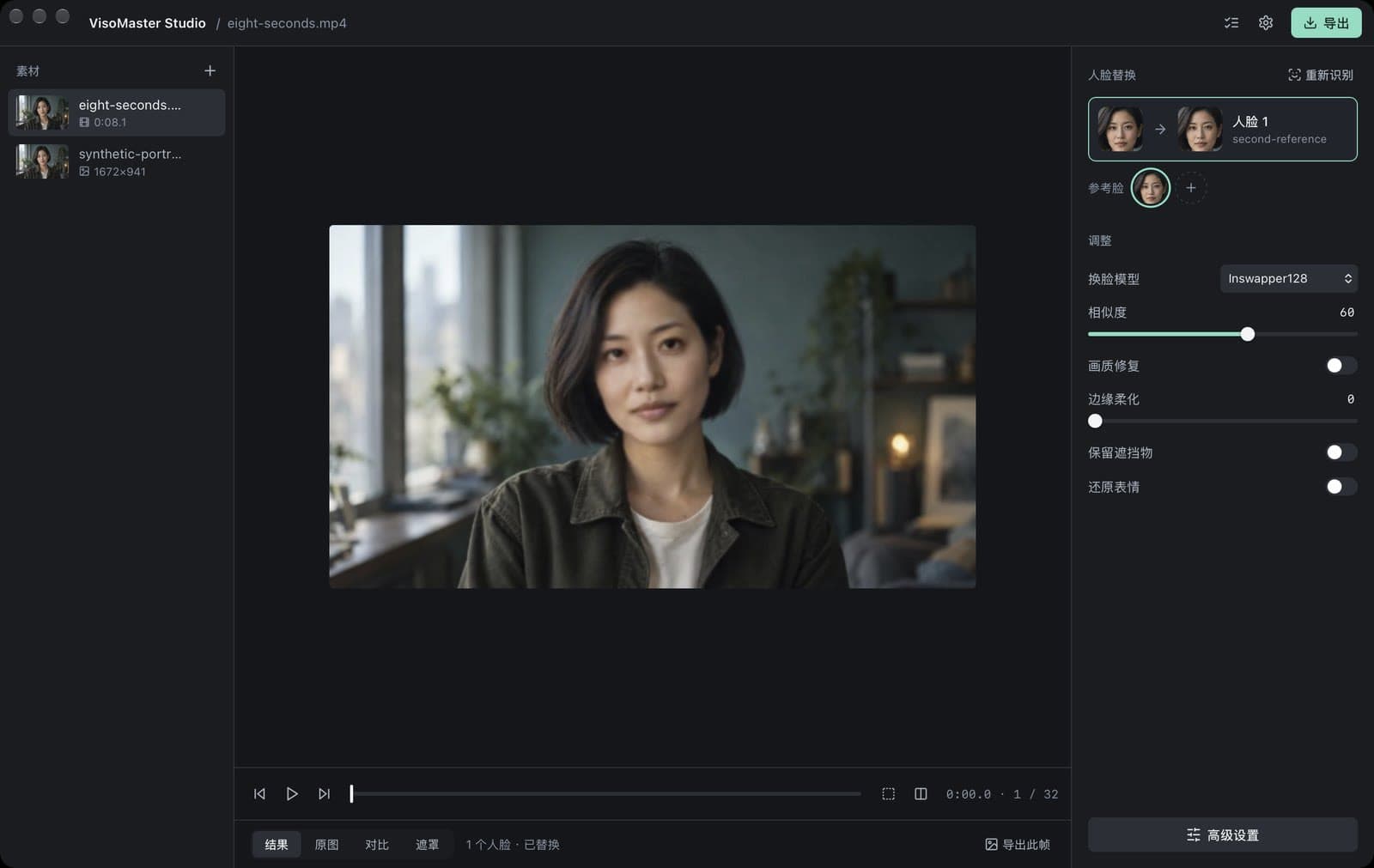
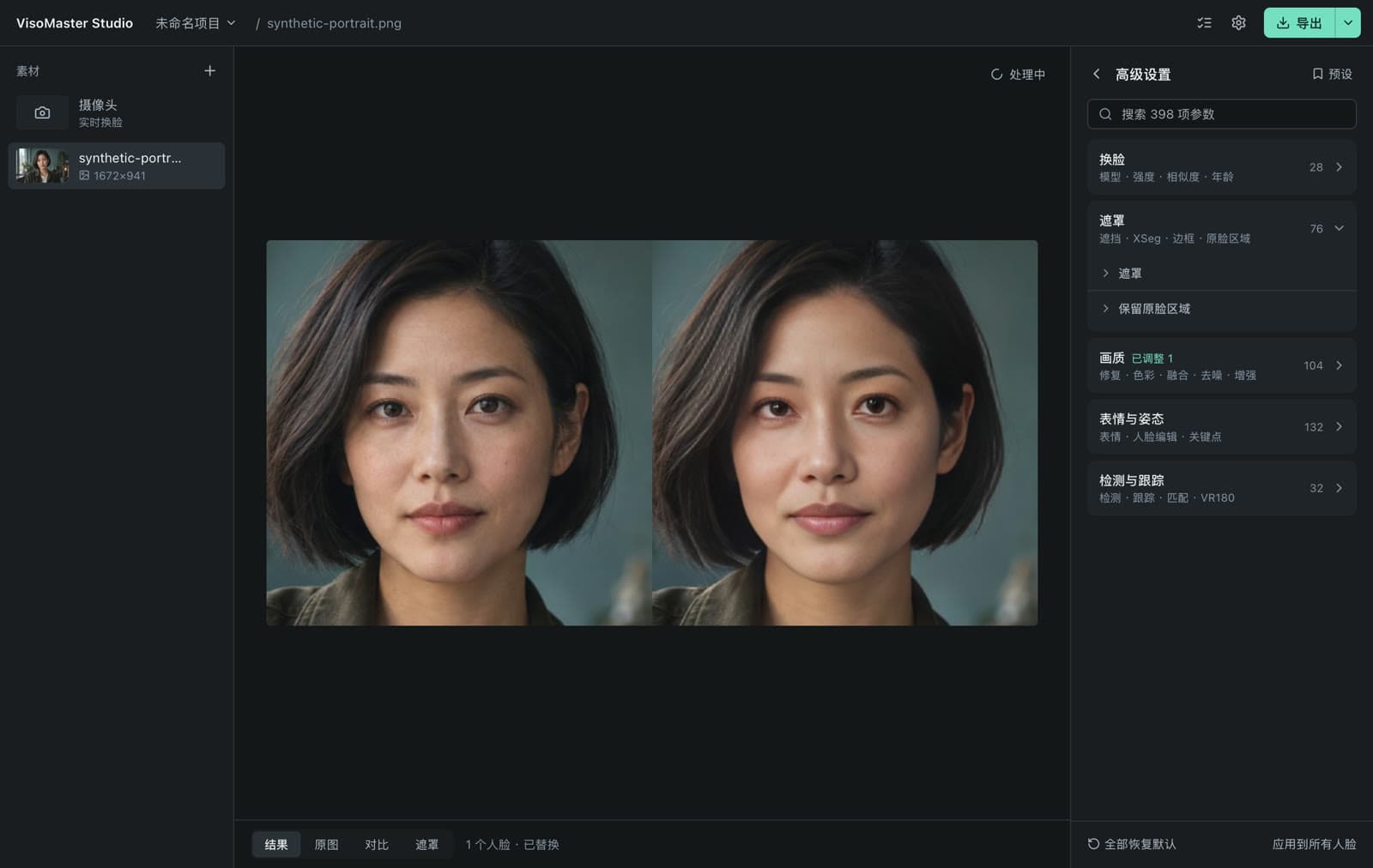
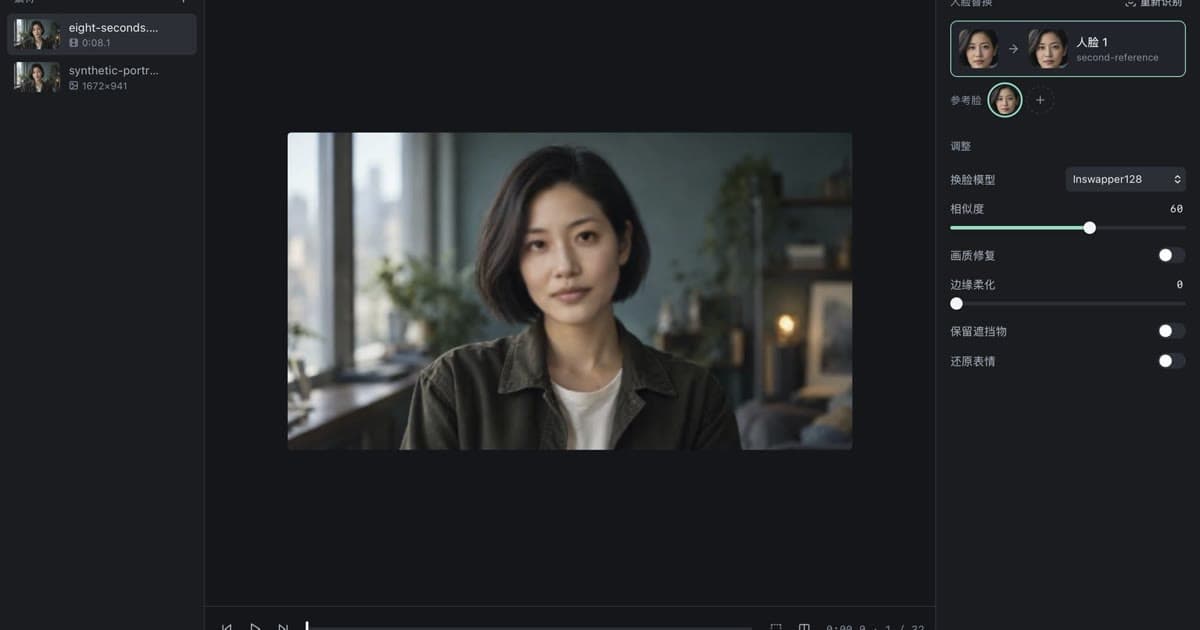
Interface. Studio shows media on the left, the preview in the centre, and the faces with six everyday adjustments on the right: swap model, similarity threshold, face restoration with strength, mask edge softness, keep occluders, and restore expression. Everything else, all 427 Fusion parameters, is in Advanced settings, grouped and searchable, with presets.
Models. Pearl is built around Inswapper128. Studio adds the other swappers listed above, each with its matching face-recognition model; Studio computes the right embedding for you. You can also import your own DeepFaceLive .dfm files. For how these models differ, see face swap models compared and using DeepFaceLive DFM models.
Video tools. Beyond markers, Studio can export a range or several segments joined into one file with the audio kept, cap output frame rate, batch-export all media, and scan for frames where a mapped face was missed. For clips with several people, see how to swap multiple faces in a video.
Projects. Studio saves projects in the VisoMaster Fusion workspace format, so the same project can be opened in Fusion.
Platforms and installation. Rope Pearl expects you to set up Python and download models yourself. Studio installers include the Python runtime and FFmpeg. Models are not bundled: the base set (about 469 MB) downloads on first launch from the models' official sources, and the rest download when a feature first needs them. The Apple Silicon build is signed and notarized for macOS 14 or later; the Intel Mac, Windows CPU and Windows NVIDIA builds are previews, meaning they are built and checked automatically but not yet widely tested on that hardware. See the installation guide and VisoMaster on Mac.
When Rope still makes sense
Rope is free and GPL-3.0 licensed, and Hillobar's newer Rope-Bronze release is the place to look if you want to stay with Rope's own interface and Inswapper-based workflow. Fusion is the right choice if you want the upstream Windows app with TensorRT, which Studio's NVIDIA package does not include. Studio fits if you want a packaged installer, a Mac build, or the single-window workflow. For how Fusion and Studio relate, see VisoMaster Fusion explained; for a comparison with another local tool, see VisoMaster vs FaceFusion.
Consent and acceptable use
Use any of these tools only with your own face or with faces you have explicit permission to use, label synthetic media, and follow local law. VisoMaster Studio's rules are in the acceptable use policy.
FAQ
Was Rope Pearl a community fork?
No. Pearl is one of Hillobar's own named releases in the main Rope repository, published in May 2024. Community forks such as Alucard24's Rope-Next builds and argenspin's Rope-Live were separate projects.
Can VisoMaster Studio load my Rope face embeddings?
Yes. The face library loads Rope's text format, where each face is a "Name:" line followed by its values, as well as VisoMaster JSON. The values are tied to one recognition model, so they apply to swappers that use that model.
Is VisoMaster a rewrite of Rope?
The VisoMaster repository does not describe itself that way. What the repositories show is that its two credited developers maintained Rope forks before VisoMaster, that VisoMaster uses a new Qt interface, and that it ships a converter for old Rope embedding files.
Does Rope Pearl run on a Mac?
Pearl's requirements pin CUDA builds of PyTorch and ONNX Runtime, so it targets NVIDIA GPUs. VisoMaster Studio has a signed build for Apple Silicon Macs and a preview build for Intel Macs.
Get the installers at visomaster.studio/download.
Author

Categories
More Posts
VisoMaster on Mac: Apple Silicon and Intel Setup Guide
Install and run VisoMaster Studio on a Mac: which DMG to pick, macOS 14, CoreML or CPU processing, first model download, data folders and logs.
DeepFaceLive DFM Models: What They Are and How to Use Them
What a DeepFaceLive .dfm model is, how DeepFaceLab and DeepFaceLive differ, and how to import and use .dfm files in VisoMaster Studio on Mac or Windows.
Face Swap Models Compared: Inswapper, SimSwap, Ghost
Inswapper, SimSwap, GhostFace, CSCS, AlphaFace and InStyleSwapper compared: input size, recognition model, license and options in VisoMaster Studio.